

How Can We Better Support Veterans at Risk for Dementia?

Post-9/11 Veterans are at higher risk of Alzheimer’s and related dementias. VA researchers are studying ways to improve vital support services for these Veterans and their caregivers.
Study Overview
Led by Erin Bouldin, PhD, MPH, a VA research team has published a new protocol paper in JMIR Research Protocols exploring how post-9/11 Veterans at higher risk of Alzheimer’s and related dementias use home and community-based services (HCBS). The goal of the study is to understand Veterans’ and caregivers’ needs, preferences, and barriers to these services, ultimately identifying ways to improve support.
The research article is freely available at https://www.researchprotocols.org/2026/1/e83629/
Why This Research Matters
Veterans have a higher risk of developing Alzheimer’s disease and related dementias (AD/ADRD) than their non-Veteran peers. This is due in part to military exposures, like traumatic brain injury (TBI). AD/ADRD is not common among people under age 65, but it does occur and is often referred to as early-onset dementia.
Not much is known about what home and community-based services (HCBS) Veterans with AD/ADRD who served in the post-9/11 era and their caregivers use. These services can help Veterans live at home and stay active and healthy. In order to design and deliver effective HCBS that promote health and well-being among Veterans and their caregivers, the current needs and preferences for HCBS among Post-9/11 Veterans with early-onset AD/ADRD and their caregivers must be understood. This study aims to fill these knowledge gaps so that tailored and effective HCBS can be tested and delivered in the future.
Study Objectives
This study aims to:
Measure HCBS use among post-9/11 Veterans with or at higher risk of AD/ADRD.
Identify facilitators, barriers, and preferences for HCBS among Veterans and family caregivers.
Prioritize HCBS interventions with input from Veterans and family caregivers.
To achieve these goals, the research team will use existing data and collect new data using interviews and preferences surveys with Veterans and caregivers. Researchers will enroll post-9/11 Veterans with ADRD, TBI, epilepsy, or cognitive impairment and their family members and friends who provide care to them. This study will quantify current HCBS use and identify barriers and needs of Veterans with or at higher risk of AD/ADRD and their caregivers. It will identify HCBS modifications that have consensus for needed changes, which will be shared with health system leaders.
Innovation and Impact
This study has the potential to impact the health and quality of life of Post-9/11 Veterans with early-onset AD/ADRD and their caregivers by better understanding both current HCBS use and preferences for these services in the future. It is innovative in its focus on younger (Post-9/11) Veterans who predominantly have early onset forms of AD/ADRD, and in its inclusion of the family caregiver. The results will inform new services and approaches to increase acceptable and effective HCBS for Veterans and caregivers.
Ultimately, these HCBS can improve the health and quality of life of Veterans and those who care for them. The proposed project will advance the mission of the Department of Defense (DoD) Peer-Reviewed Alzheimer’s Research Program to reduce the burden of AD/ADRD on affected individuals and caregivers, especially in the Military and Veteran communities.
This study is funded by the U.S. Department of Defense (DoD) and supported by the Western Institute for Veterans Research (WIVR), UT Health San Antonio, the University of Utah, the, and the U.S. Department of Veterans Affairs (VA).
References
Bouldin ED, Cheney A, Pugh MJ, Morales K, Delgado RE
Home- and Community-Based Service Use and Preferences Among Post-9/11 Veterans With or at High Risk of Alzheimer Disease and Related Dementia and Their Caregivers: Protocol for a Mixed Methods Observational Study
JMIR Res Protoc 2026;15:e83629
doi: 10.2196/83629
PMID: 42054703
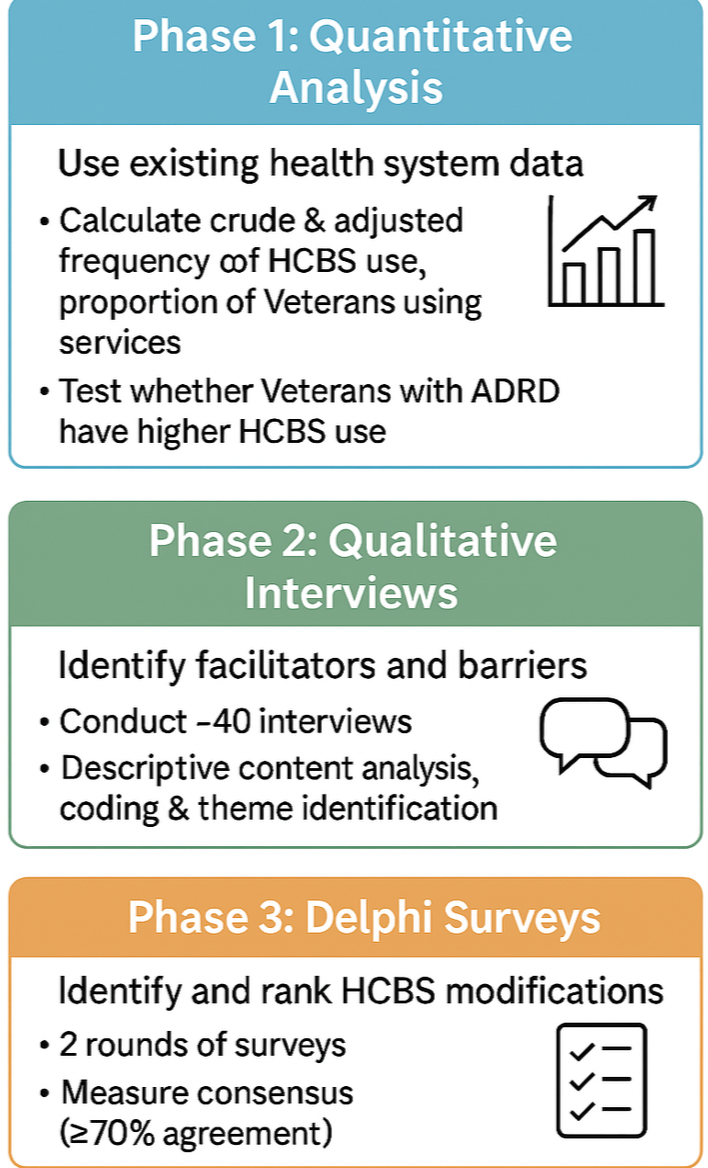
Figure 1. Summary of study activities for each aim (phase). Reproduced with permission from Bouldin, E. D., Cheney, A., Pugh, M. J., Morales K., & Delgado, R. E. (2026). Home- and community-based service use and preferences among post-9/11 veterans with or at high risk of Alzheimer's disease and related dementia and their caregivers: protocol for a mixed methods observational study. JMIR Research Protocols. https://doi.org/10.2196/83629
ARTICLE TITLE:
Home- and Community-Based Service Use and Preferences among Post-9/11 Veterans With or at High Risk of Alzheimer's Disease and Related Dementia and their Caregivers: Protocol for a Mixed Methods Observational Study
JOURNAL:
JMIR Research Protocols
AUTHORS:
Erin D Bouldin, MPH, PhD; Amanda Cheney, BS; Mary Jo Pugh, PhD, RN; Kayla Morales, PhD; Roxana E Delgado, MS, PhD
ARTICLE PUBLICATION DATE:
April 29th, 2026
RESEARCH KEYWORDS:
frontotemporal dementia, early-onset dementia, traumatic brain injury, home-and community-based services, personal health services, patient preference, independent living, observational study
DOI:
Cover Image Designed by Freepik. www.freepik.com
